Database Architecture
DBMS Architecture helps in designing, developing, implementing, and maintaining the database. Depending upon where the database is stored, the database architecture is classified. The first one is the underlying computer system on which the database runs is a Database Management System that is not always directly available for users and applications to access and store data in it. The database Management systems can be centralized, decentralized, or hierarchical, depending on their structure. The second one is how the users are connected to the database to get their request done, that is, whether the user is directly connected to the server to access data or through the API.
Types of DBMS Architecture
Database Management System provides three main types of architecture which are illustrated below.
- 1-Tier Architecture
- 2-Tier Architecture
- 3-Tier Architecture

1-Tier DBMS Architecture
It is also called Single-Tier Architecture. This type of architecture is generally preferred in the conventional file system. In this architecture, the database is directly available to the user because, the client, server, and database together reside in a single system (in the client system). If we need to change any data we can directly change it in the database and no internet connection is required to perform operations on the database. This architecture is used where data does not change frequently and where multiple users accessing the system for local application development, where programmers communicate directly with the database for a quick response. This type of architecture is preferred by the Database Administrator while designing the database.
2-Tier DBMS Architecture
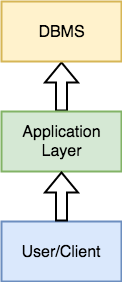
It is also called a Client-Server Architecture. In this architecture, the database resides in the server system and the application programs reside on the client system. The 2-tier DBMS architecture consists of an application layer between the user and the DBMS, which is used to send the user's request to the database management system and then send the response from the DBMS to the user. The application program communicates with the database using the ODBC (Open Database Connectivity). An application interface known as ODBC (Open Database Connectivity) provides an API that allows the client-side programs to call the DBMS. Most DBMS vendors provide ODBC drivers for their database management system. A network connection is required to communicate with the database. The client-side- application establishes a connection with the server side to communicate with the DBMS. The server side is responsible for the functionalities like query processing, transaction management, etc.
For example, at the railway reservation counter, where the clerk acts as the client and he can access the railway server for the required data directly.
Advantages of 2-Tier Architecture
- It runs faster as it is directly communicating with the server.
- Easy maintenance.
Disadvantages of 2-Tier Architecture
- Scalability issues.
- Security is less as the client can access the server directly.
3-Tier DBMS Architecture
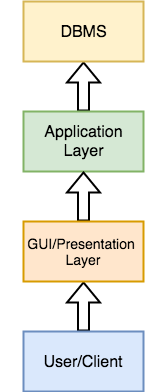
This architecture is also called Internet-Based Architecture and it is most commonly used in web applications. It is an extension of the 2-Tier Architecture, and another layer is added in this architecture called GUI (Graphical User Interface) that resides in the client system and provides a GUI (graphical user interface) for the end-users so that they can interact with the DBMS. For the end-user, the GUI layer is the Database System, and the end-user has no idea about the DBMS system. By using the GUI through the application layer, the end-user communicates with the database to retrieve the required data. An example of a 3-Tier DBMS is PHPMyAdmin.
Advantages of 3-Tier Architecture
- Scalability- Like in 1-Tier and 2-Tier architecture, individual connection need not be required between the client and server because of the deployment of application servers.
- Security- In this architecture, security is improved because this model prevents the direct interaction of the user or client with the server.
- Data Integrity- As the middle layer present between the client and server, data corruption can be avoided and can maintain data integrity.
Disadvantages of 3-Tier Architecture
- Complexity is increased due to the implementation and communication.
n-Tier DBMS Architecture
This architecture is also called Multi-Tier Architecture. The n-tier architecture divides the whole system into independent n modules that are related to each other, which can be independently modified, altered, changed, or replaced. The number of tiers is dependent upon the business requirements. It is the extension of the 3-tier architecture and includes all its advantages.
This architecture includes three sub-tier Presentation Tier, Logic Tier, and Data Tier.
- Users can directly interact with the Presentation Tier, it is like an interface between the user and the data that the user access.
- The Logic Tier is responsible for making logic decisions, commands perform evaluation, calculation and it also transfers the data between the presentation tier and data tier.
- The Data Tier consists of storage in which actual data is stored and retrieved.
Advantages of n-Tier Architecture
- Multi-Tier Architecture is more scalable than others.
- This architecture is more secure.
- It can be easily maintained.
Conclusion
In this tutorial, we have discussed the DBMS Architectures and their purposes. We understood the three types of DBMS architecture and how it works.
