The Enhanced ER Model
As the complexity of data increased in the late 1980s, it became more and more difficult to use the traditional ER Model for database modeling. Hence some improvements or enhancements were made to the existing ER Model to make it able to handle complex applications better. Hence, as part of the Enhanced ER Model, along with other improvements, three new concepts were added to the existing ER Model. These concepts are illustrated below.
Hence, as part of the Enhanced ER Model, along with other improvements, three new concepts were added to the existing ER Model, they were:
- Generalization
- Specialization
- Aggregration

Let's understand what they are, and why were they added to the existing ER Model.
DBMS Generalization
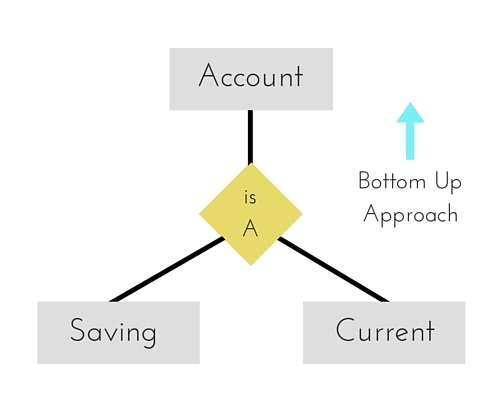
A generalization is a bottom-up approach in which two lower-level entities combine to form a higher-level entity. In generalization, the higher-level entity can also combine with other lower-level entities to make further higher-level entities. It's more like a Superclass and Subclass system, but the only difference is the approach, which is bottom-up. Hence, entities are combined to form a more generalized entity, in other words, sub-classes are combined to form a super-class.
For example, Saving and Current account types entities can be generalized and an entity with the name Account can be created, which covers both.
DBMS Specialization
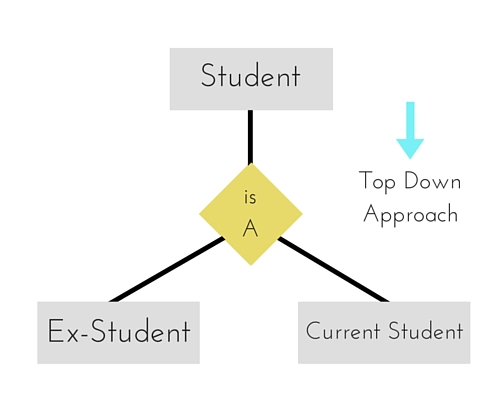
Specialization is the opposite of Generalization. It is a top-down approach in which one higher-level entity can be broken down into two lower-level entities. In specialization, a higher-level entity may or may not have any lower-level entity sets. It is used to recognize the subset of an element set that shares some distinctive qualities. Normally, the superclass is defined first, the subclass and its related attributes are defined next, and the relationship set is added n the last.
DBMS Aggregation
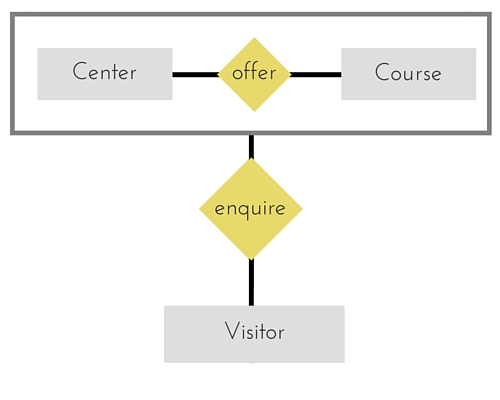
Aggregation is a process when a relation between two entities is treated as a Single Entity. In aggregation, the relationship with its corresponding entities is aggregated into a higher-level entity.
For example, in the diagram below, the relationship between Center and Course together is acting as an Entity, which is in a relationship with another entity Visitor. Now in the real world, if a Visitor or a Student visits a Coaching Center, he/she will never enquire about the center only or just about the course, rather he/she will ask to enquire about both.
Conclusion
In this article, we discussed different concepts of ER Model which includes Generalization, Specialization, and Aggregation with examples and diagrams.
